Why a chef coat is a poly-cotton blend and not cotton
Every coat and nearly every shirt in this range is 65 per cent polyester and 35 per cent cotton, and cooks ask why it is not the cotton they would choose for a shirt. The answer is not cost. It is what a commercial wash at high temperature does to cotton, what all-polyester does to a cook standing over a flat top, and what a twill weave with a stain-release finish does about both.
The hand is only part of the decision
Cotton feels good when you pick up a chef coat. It has a familiar softness and a natural hand, so an all-cotton coat can seem like the obvious choice for a working kitchen. Then the uniform order reaches the practical questions. How will the coats come through repeated washing? Will they keep their shape? How much time will the laundry team spend pressing them? What happens when the same cook needs a clean coat for every shift?
A coat has to do more than feel comfortable on a hanger. It has to work as part of a uniform system, alongside shirts, pants, aprons and neckerchiefs. That system has its own laundry routine, replacement costs and expectations from the kitchen team.
Nearly every coat, shirt and pant we cut is a 65 per cent polyester, 35 per cent cotton blend, woven as a twill. We use that construction because it balances several demands rather than favouring one. Cotton contributes a familiar feel. Polyester helps the garment hold its shape and manage the repeated work of laundering. The twill weave gives the cloth a firm surface for a coat that has to stand up to daily use.
That does not make cotton a poor fibre. It means an all-cotton coat asks more from the laundry process, while an all-polyester coat can ask more from the person wearing it. Our blend sits between those two choices.
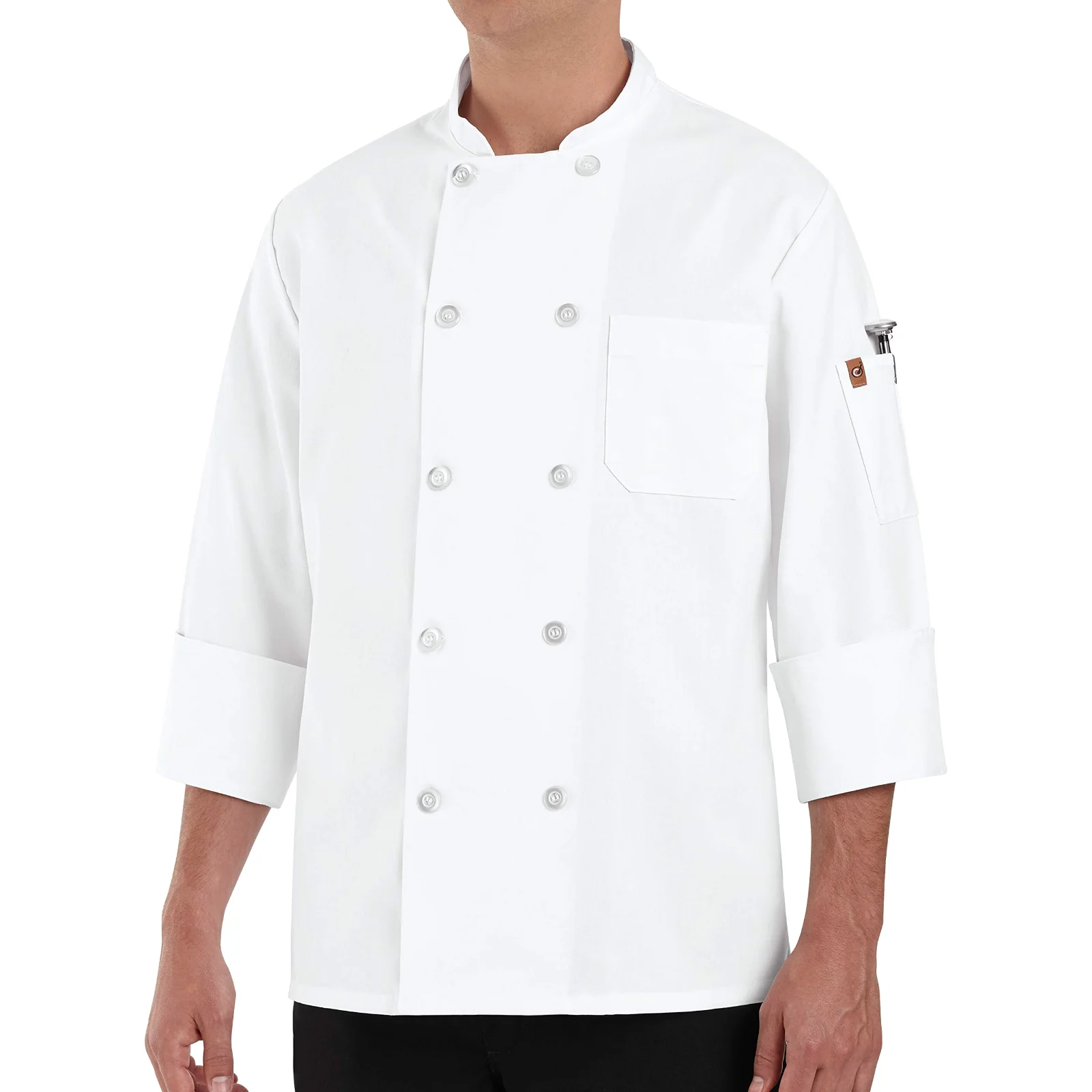
The decision is also about consistency. We cut coats with a stand-up collar, vented clean-finished cuffs and a left chest pocket. On our pearl-button coats, there is also a thermometer pocket on the left sleeve. Those details matter more when the garment keeps its proportions after washing.
A uniform order is rarely about one pleasant first impression. It is about the coat after many shifts.
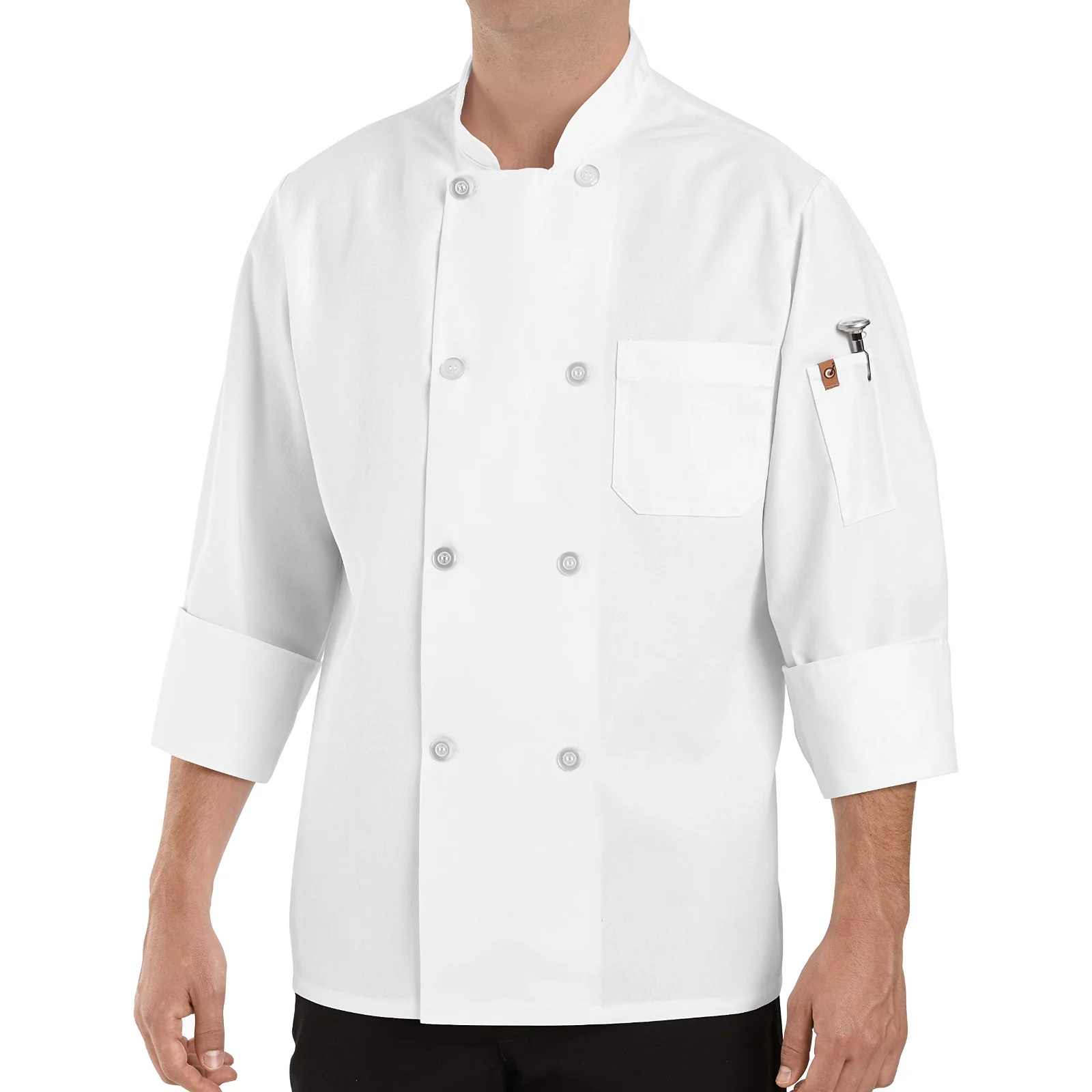
Chef Designs Eight Pearl Button Chef Coat
Stand-up collar · Sizes XS to 5XL, plus L Tall to 3XL Tall · Chest pocket
$21.32
What all-cotton asks of a commercial wash
Cotton shrinks in the wash, and heat and repetition are what a commercial laundry is made of. Half an inch matters in a coat. It moves the collar, it takes the cuff off the wrist bone, and after a season it leaves you with a rack of coats that no longer match each other.
Creasing is the second cost, and it is paid in labour rather than in cloth. Cotton comes out of a wash needing a press before it is fit to be seen at a pass. Multiply that by three coats a cook and a brigade of eight, and the question stops being what a coat feels like and becomes how many garments somebody has to iron on a Tuesday morning.
For a kitchen that owns three coats per cook, the effect is multiplied. Shrinkage has to be considered across the set. Creasing can mean more pressing. Longer drying can affect the pace of the laundry routine. None of those points makes cotton unusable. They make it a choice that needs more attention.
Our coats are pre-shrunk before we cut them. That helps us begin with a garment designed for more predictable sizing, but it does not turn laundering into a fixed science. The care label still governs the washing routine, and the laundry conditions still matter.
Why all polyester is not the simple answer
All-polyester fabric can make sense in some parts of a uniform system. Polyester is present in nearly every coat, shirt and pant we cut, and it contributes useful performance to the 65/35 blend. Removing the cotton does not automatically improve the whole garment.
On a hot line, an all-polyester coat can hold heat against the body. A cook working over equipment and moving through an active kitchen notices the conditions inside the coat, not only how it looks after laundering. Comfort is not a decorative concern. It affects how willing someone is to wear the uniform through a full shift.
We also take a practical view of what a coat needs to do. It needs to present a consistent uniform appearance, keep its basic structure and move through a laundry routine without creating unnecessary work. It also needs to be acceptable to the cook wearing it. Those requirements can pull in different directions.
The hand of a 65/35 twill is part of that balance. It is not the same as an all-cotton cloth, and it is not the same as an all-polyester cloth. A buyer who wants one answer for every kitchen condition will probably be disappointed. Uniform decisions depend on the work, the laundry setup and the people wearing the garments.
One buyer found a coat a little too warm for an active kitchen. That experience deserves a place in the decision. We do not describe the blend as cool in every situation, and we do not promise that one fabric will suit every person.
| Property | All-cotton | All-polyester | 65/35 polyester-cotton twill |
|---|---|---|---|
| Hand and wear comfort | Familiar cotton hand | Can hold heat against the body | Balances cotton hand with polyester |
| Shrinkage and creasing | More shrinkage and creasing concern | Holds shape more readily | Pre-shrunk and designed for shape retention |
| Drying routine | Can stay wet longer | Typically manages drying more readily | Balances laundry handling with cotton content |
| Surface for finishes | Can support a finish | Can support a finish | Twill surface used with stain-release finish |
What the twill and the ratio contribute
The 65/35 ratio is not a label detail without a purpose. It describes the balance we put into nearly every coat, shirt and pant in the range. Sixty-five per cent polyester and 35 per cent cotton are woven as a twill, giving the cloth a structured surface rather than a flat, delicate one.
That structure helps the garment hold its shape through regular use. A chef coat has points that need to remain recognizable, including the stand-up collar, cuffs, placket and pocket placement. Shape is not only about appearance. It affects how the coat sits on the body and how the uniform looks when several people are dressed alike.
The shoulder and placket also receive repeated abrasion. Arms move, coats are put on and removed, and the front of the garment is handled throughout the working day. Twill gives the cloth a surface suited to that kind of contact. We do not describe it as indestructible, and we do not assign it a fixed service life. The point is more precise: the weave is part of how we build a coat for regular kitchen use.
The surface also gives a stain-release finish something to do. Our coats carry that finish, while the bib apron carries a soil-release finish. These treatments are part of the garment construction, not a guarantee that every mark will disappear in every wash.
Cotton alone can provide a familiar hand, and polyester alone can bring useful shape and dye performance. The 65/35 twill combines those roles in one cloth. That balance is the reason we use the blend across nearly the whole range.
The neckerchief is different. It is an 80/20 poly-cotton rather than the 65/35 blend used for nearly every coat, shirt and pant. The distinction is printed in the fibre content, so it should not be guessed from appearance.
What the finishes do, and what they do not promise
Several terms in a uniform description refer to how we build the garment. They are useful terms, but they should not be read as promises about every laundry room or every stain.
Our coats are pre-shrunk before cutting. That means the cloth receives this preparation before we cut the coat pieces. It supports more predictable sizing from the start. It does not mean a coat cannot change under every possible washing or drying condition.
The coats also carry a stain-release finish. That finish is intended to help with the way stains release from the garment during laundering. It is not a claim that a coat will stay spotless, that every mark will leave in one cycle, or that the finish replaces a suitable care routine.
The bib apron has a soil-release finish. Soil and stain are related laundry concerns, but the terms are not interchangeable descriptions of a magic surface. The finish is one part of the apron construction. The rest of the result depends on the garment, the soil and the washing process.
Our cook pants are wrinkle resistant. That describes a built-in characteristic of the garment. It does not mean the pants will never show a crease, or that every dryer program will leave them looking the same. Several product cards also say “industrial laundry friendly.” Read that as a description of intended laundry use, not as a promise that any process will produce an identical result.
A pearl button on one of our white coats is chosen for one property in particular: it holds its colour under industrial laundry processing rather than going yellow. That is a claim about the button and about that named condition, and nothing more. The cloth around it is a separate question, and so is what a particular laundry runs.
We prefer this plain reading because uniforms are working tools. They deserve useful descriptions, not sweeping claims.
How to read the label before the first wash
The sewn-in label is the document to follow for washing. It is not a suggestion printed for decoration. Under the US Federal Trade Commission Care Labeling Rule, a washing instruction covers the washing method, bleaching, drying, ironing where needed and warnings. The maker must hold reliable evidence for those instructions, and the label must be attached permanently and securely and remain legible for the useful life of the garment.
That gives the label a specific role in the laundry room. Product descriptions can help you compare garments before an order, but the attached care label governs the garment in hand. Read it before setting a program or passing the coat into a commercial laundry routine.
The FTC textile labelling guidance covers a different set of information. A label must give fibre content by generic name and percentage by weight in descending order. It must also state the country where the garment was processed or manufactured, along with the maker or marketer by name or registered identification number. Only fibres that make up five per cent or more are named, unless a lower-percentage fibre is functionally significant. Otherwise, a fibre below five per cent is identified as “other fibre.”
That is why the 65/35 content is useful information rather than vague fabric language. It tells you the principal fibres and their proportions by weight. The neckerchief’s 80/20 content is likewise a defined blend.
Flammability is covered by 16 CFR 1610, the clothing flammability standard. It applies to clothing textiles sold in the United States. The standard exempts plain-surface fabrics of 2.6 ounces per square yard or more, as well as fabrics made entirely of acrylic, modacrylic, nylon, olefin, polyester or wool. A 65/35 blend is not made entirely of an exempt fibre.
That point does not turn a fibre label into a use instruction. It tells you that the standard has defined scope and exemptions. The care label still governs laundering.
The exceptions, and the practical conclusion
Two garments in our range step outside the usual twill construction. The black chef coat and the black long cook shirt are spun polyester rather than the 65/35 polyester-cotton twill used for nearly every other coat, shirt and pant.
The reason is specific. Spun polyester holds a dye better under commercial laundry chemistry. That makes the construction relevant when the garment’s black colour is an important part of the uniform plan. We do not use that detail to claim that every black garment will look unchanged forever. It explains the choice of fabric for those two garments.
The exception also shows why a uniform range should not be reduced to one rule. Most of our coats use the blend because it balances cotton hand, polyester content, twill structure and laundry considerations. The black chef coat and black long cook shirt use spun polyester for a different colour-retention need. The neckerchief uses an 80/20 blend. Different garments can have different jobs.
So, what should you take from the comparison? All-cotton has a familiar feel, but shrinkage, creasing and longer wet time can add demands to a commercial wash. All-polyester can help with shape and laundry handling, but it can hold heat against the body on a hot line. The 65/35 twill sits between those choices, with pre-shrinking and a stain-release finish used as part of our coat construction.
That balance is not a promise that every cook will find the coat equally cool, or that every mark will disappear without attention. One buyer found a coat too warm for an active kitchen. Another dishwasher reported that white shirts bleached at every wash without fabric degradation, while a cook said four pairs of cook pants did not fade and came out of a dryer smooth. Those experiences can inform a decision, but they do not replace the label.
More of this sort of thing is in From the Pass, we at Chef Designs keeps the whole range one click away on the front page, and the sources behind every sun and label claim are listed on how we update the catalogue.