What an industrial laundry does to your whites that a home machine does not
A linen service washes hotter than a domestic machine, with chemistry a home wash never sees, and it is the reason a cheap coat is grey by March. What "industrial laundry friendly" is actually claiming, why a button is chosen for its behaviour under bleach, what pre-shrunk and stain release mean, and what the care label is still the last word on.
The March test
March is when a kitchen notices. The coats came in September, and now the whites are not white any more.
Grey is not failure. It is six months of food soil, hot washing, drying and pressing, and white is the one colour that keeps the receipt. What makes it obvious is that it happens to the whole rack at once: one coat looking tired reads as a bad coat, twelve reads as a uniform.
You may first notice it at the pass, under bright lights. One coat looks grey around the front. Another has a darker collar. The bib apron that looked clean at the start of service carries the day in its colour, even after laundering.
We cut our coats and shirts in a pre-shrunk 65/35 poly-cotton twill. Our coats also have a stain-release finish. The fabric and finish are part of the garment’s working design, but neither one can remove every mark forever.
A kitchen also has choices beyond the cloth itself. The buttons matter. The apron worn over the coat matters. So does the point at which a mark is washed, and the care label that stays attached to the garment.
The good news is that several parts remain within your control. A rotation can reduce pressure on each garment. An apron can take the first contact with food soil. A loose knot button can be replaced before it becomes a missing button.
White workwear needs a plan.
What a commercial wash actually does
An industrial laundry does more than place a garment in a larger version of a home machine. The wash is hotter than a domestic machine, and it uses chemistry that a home wash never sees. Afterward, the garment goes through a press.
At home, you might wash a shirt with other household clothing and dry it in a domestic dryer. An industrial laundry handles workwear as workwear. Its process is built around returning garments to service after contact with food, soil, and the rest of a kitchen shift.
The press adds another stage. A coat that leaves the wash and dryer is then pressed flat, bringing heat and pressure to the front, collar, cuffs, and other parts of the garment. That finish can make a uniform ready for the next working day, but repeated pressing also makes button construction worth considering.
| Part of the process | Commercial wash | Domestic wash |
|---|---|---|
| Washing conditions | Hotter than a domestic machine | Household washing conditions |
| Chemistry | Industrial chemistry that a home wash never sees | Domestic laundry products |
| Finishing | A press follows the wash and drying process | A home dryer may be the final stage |
| Garment demands | Built around repeated workwear processing | Usually part of a household laundry routine |
One buyer has written that a white shirt went through a dishwasher’s laundry routine at every wash without fabric degradation. Another cook has written that four pairs of cook pants did not fade and came out of a dryer smooth. Those experiences are useful as individual reports, not as a replacement for the care instructions.
A commercial wash tests the whole garment. The cloth is only one part of it.
Why buttons decide more than cloth does
A coat can survive a wash that its buttons do not. That is why the buttons on our white coats are specified separately from the cloth: they are made not to yellow under industrial laundry processing, which is a different requirement from holding a seam. Knot buttons are the other end of the same problem, tied rather than moulded, and a commercial dryer finds them eventually.
Bleach is part of the concern. White buttons can yellow under industrial laundry processing if they are not made for that environment. A yellowed button changes the appearance of a white coat quickly, even when the twill itself still looks sound.
The pearl buttons on our white coats are made not to yellow under industrial laundry processing. That is a specific design point. It does not mean every button on every coat behaves in the same way, and it does not remove the need to follow the care label.
There is another difference between a moulded button and a knot button. A moulded button is formed as one piece. A knot button is tied. One of our coats closes with knot buttons, and those buttons survive being pressed flat. A commercial dryer works one loose eventually, so kitchens that buy that coat keep spares.
The loose button is not a reason to discard the coat. It is a reason to include a simple repair in the uniform routine. A card of spares can sit with the items used for garment care, ready for the next repair rather than the next emergency.
Pressing also gives a moulded button its own moment of risk. A press works flat across the garment, while the button sits in its path. The construction has to suit that repeated contact. With a knot button, the dryer rather than the press is the point to watch.
A buyer has also written about a bib apron seam letting go the first time it was laundered. That report is a reminder that seams and fastenings deserve attention alongside fabric colour.
Look at the whole uniform. The cloth, closure, seam, and pocket all have to live through the same working cycle.
Pre-shrunk, stain release, soil release
The garment meets its features in an order. First comes the cloth, then the soil on the job, then the wash and finish that follow.
Our coats and shirts use a 65/35 poly-cotton twill. The fabric is pre-shrunk before cutting. That preparation addresses shrinkage before the garment reaches you. It does not promise that a coat will remain untouched by every later washing condition, nor does it promise that the coat will keep the same appearance forever.
A stain-release finish is used on the coats. Its job is part of the garment’s design, helping with the way stains meet the coat during work and laundering. It does not make the coat stain-proof. Sauce, grease, colour, and time can still leave a mark.
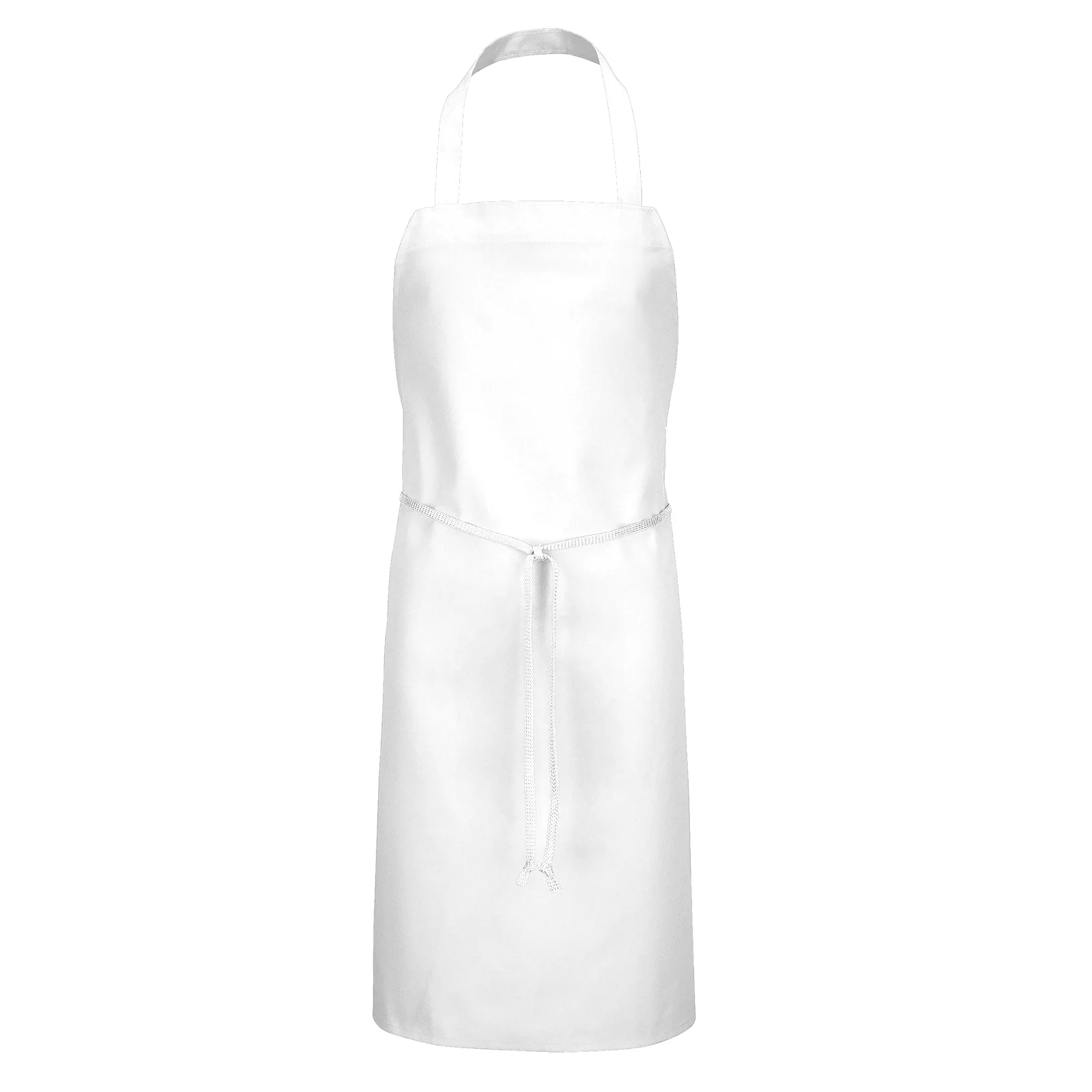
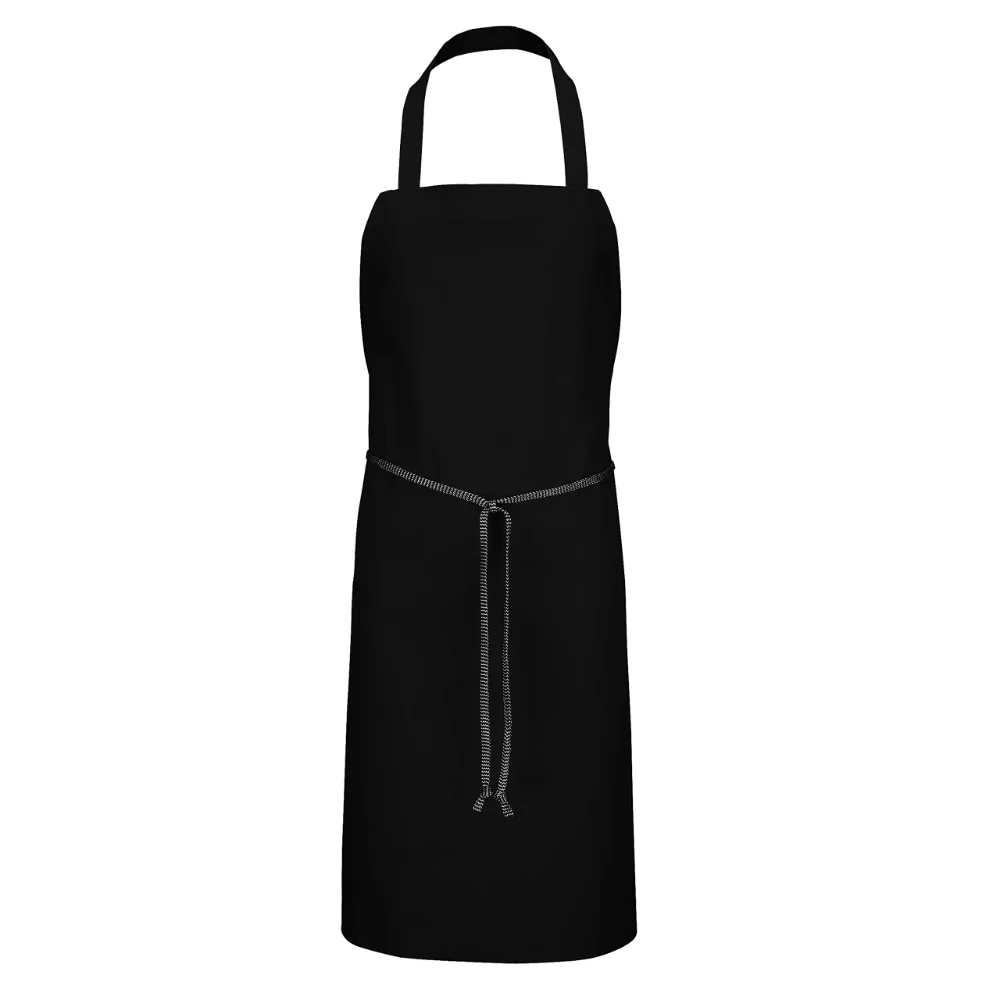
The bib apron has a soil-release finish. That is a different description for a layer that sits between the kitchen and the coat. Soil release does not mean that an apron can take every shift without showing use. It does not replace a wash, a rotation, or a change after a spill.
Pre-shrunk, stain release, and soil release are useful terms only when kept precise. They describe construction and finish. They do not promise a particular result from every laundry contract or every chemical process.
A finish can support the routine. It cannot replace the routine.
The practical response is to deal with marks while they are still part of the day’s work. If a garment comes back with a persistent mark, note where it sits and how the garment was processed. The care label remains the guide. No finish gives a kitchen permission to ignore it.
Why the apron is the layer that gets changed
A coat can be clean at the start of service and need protection by the end of it. That is the apron’s job in the uniform system. It takes contact sooner, and it can be changed without changing the whole coat.
The US Food and Drug Administration Food Code is a model code that state and local jurisdictions adopt for retail food safety. It requires food employees to wear clean outer clothing to prevent contamination of food, equipment, utensils, and linens. The wording makes the outer layer part of the working control, not a decorative extra.
Our apron range gives a kitchen different ways to create that layer. The full bib uses tubular braid ties. The premium short bib has a three-section pocket and an adjustable neck strap with a plastic buckle. There is also a waist apron and a cobbler that pulls over the head.
The arithmetic of a rotation is straightforward. If one person needs one apron in service and one apron is in the laundry cycle, that is two aprons for that person. Add one more if the kitchen expects a mid-service change, and the working rotation becomes three.
That simple count is easier to manage than asking one coat to carry every mark until the next laundry return. A spare apron can step in after a spill, during a long service, or when the first apron has reached the point where clean outer clothing needs to be restored.
The same logic applies across a team. Five people with one apron each have five aprons in the rotation. Five people with one in service and one in laundering need ten. If each person also needs a change during service, the count rises to fifteen.
Those numbers do not describe a laundry contract. They describe coverage. The right number depends on your service pattern and how often garments return.
Changing the apron protects the coat, but it also gives the kitchen a clear response to visible soil. The outer layer can leave the line before the coat does.
What the care label has the last word on
A website page can explain a garment. The care label has the last word on caring for that garment.
The US Federal Trade Commission Care Labeling Rule requires a care instruction to cover the washing method, bleaching, drying, ironing where needed, and warnings. The maker must hold reliable evidence for those instructions. The label must also be attached permanently and securely, and it must stay legible for the useful life of the garment.
That is a high standard for a small label. It is meant to remain with the garment through the work it was made to do. A page may describe a range, while the label sits inside the specific coat, shirt, or apron in your hands.
Read it before setting a laundry routine. Washing method affects the first stage. Bleaching affects the appearance of white components, including buttons. Drying matters for garments with details that meet commercial equipment. Ironing matters when a press or another hot finish is part of the process.
Warnings matter too. They are not filler around the useful information. They tell you where the instruction has a boundary.
Our cards may say “industrial laundry friendly,” but that phrase does not override the attached care label. It describes how the garment is built, not a particular contract, machine, or chemistry. If a page and the label appear to disagree, follow the label for the garment.
The rule is also why the label outranks anything written on a card. A maker has to hold reliable evidence for the instruction printed on it, and the label has to stay attached and legible for the life of the garment, which is exactly the stretch of time your rotation covers. A card is a description; the label is the document.
Keep the label readable. Do not cut it away before recording what it says. A uniform order is easier to manage when the people sending garments to laundry and the people receiving them are working from the same instruction.
The page gives context. The label directs care.
What your kitchen can control
March does not arrive as a surprise if the uniform routine has a few clear decisions behind it. You cannot make a working white coat ignore every mark, but you can decide how much work each garment carries before it is washed.
Start with rotation. Count the apron needed in service, the apron in the laundry cycle, and any extra apron required for a mid-service change. Two aprons per person cover one in use and one in laundering. Three add a change for the shift.
Use the apron as the first replaceable layer. A full bib with tubular braid ties, a short bib with its adjustable neck strap and plastic buckle, a waist apron, or a cobbler that pulls over the head can all serve a different working pattern. The useful choice is the one that fits the way your kitchen changes outer clothing.
Change an apron mid-service when it has taken the soil you do not want carried through the rest of the shift. A clean outer layer supports the food-safety requirement for food employees to wear clean outer clothing.
Wash a mark before it dries in. That does not guarantee removal, and it does not replace the care label. It simply gives the garment less time to hold onto the mark before laundering.
Then inspect the details, not only the white area. Check the button line, seams, pockets, ties, straps, and closures. One buyer found a bib apron seam had let go during its first laundering. Early inspection gives you a chance to respond before the next service.
For a coat with knot buttons, keep a card of spares. When the commercial dryer works one loose, replace it rather than waiting for the closure to become incomplete. The buttons are tied, so the repair belongs in the rotation plan.
Finally, read the attached care label and keep it legible. Our coats and shirts are made in pre-shrunk 65/35 poly-cotton twill, with stain release on the coats. The bib apron has soil release. Those features support the routine, but the routine still belongs to you.
White workwear lasts into the next season through ordinary controls: rotate it, cover it, change it, wash it, and repair it.
More of this sort of thing is in From the Pass, the Chef Designs bench keeps the whole range one click away on the front page, and the sources behind every sun and label claim are listed on how we update the catalogue.