How to size a chef coat over the shirt you already work in
A coat that fits in a fitting room and binds across the back when you reach into an oven was sized over bare skin. Where to put the tape, why a double-breasted front needs the larger of two letters, what a tall run changes that a bigger letter does not, and how to read a waist-by-length code on a cook pant without guessing.
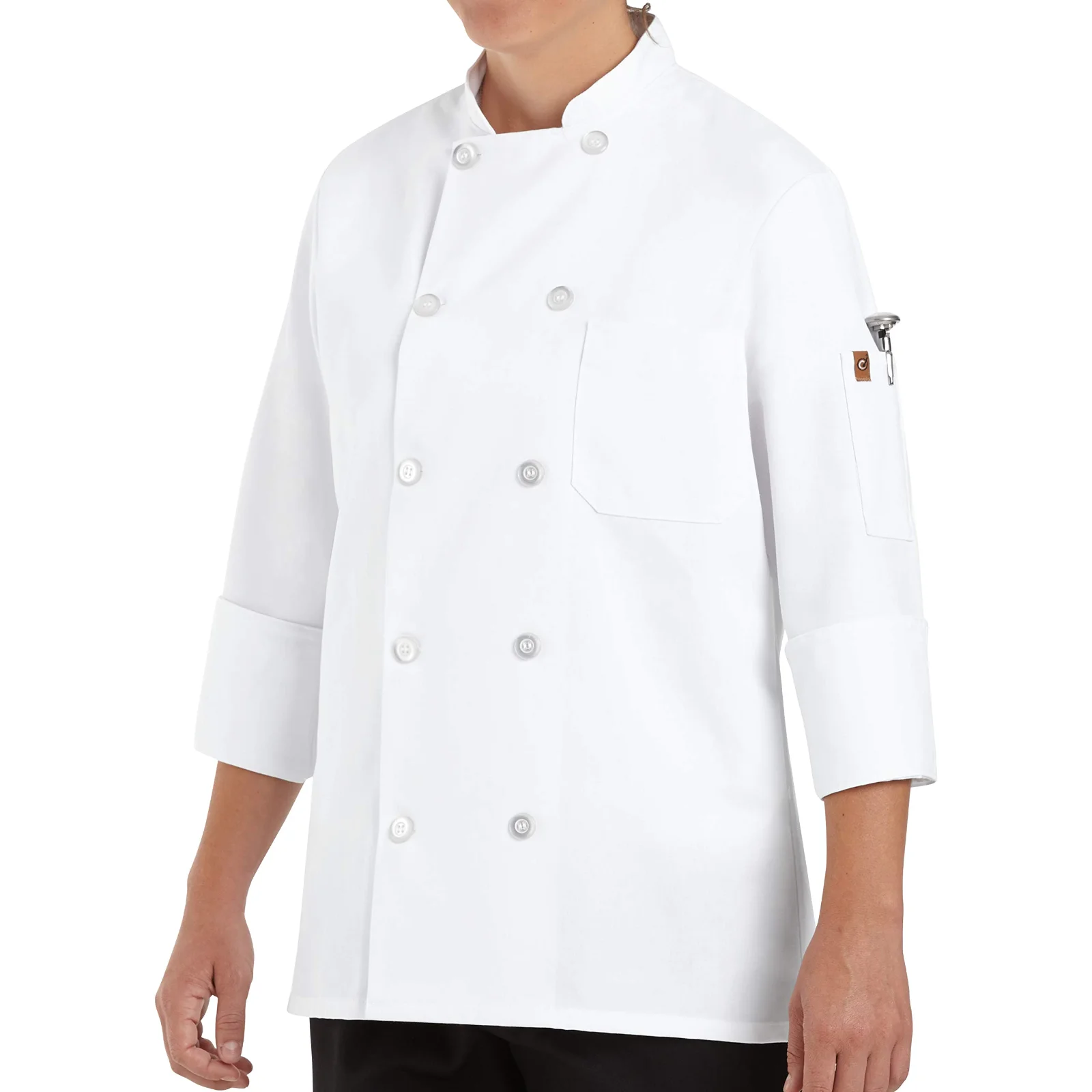
Start with the layer you actually wear
The exchange often starts with two small guesses. You take the letter from a T-shirt, then judge the coat from a photograph. That letter may feel familiar, and the photograph may look clear. Neither tells us enough about how our chef coat will sit over the shirt you already work in.
A kitchen coat is part of a working setup, not a bare-skin fit. The shirt underneath takes up room across your chest, back, and arms. Your usual stance takes up room too. You reach into a cooler, turn toward a range, lift a pan, and bend across a prep table. A coat that looks right with the front hanging open can feel very different once it is done up.
Start with the garment and layer you plan to wear. If your kitchen shirt is usually on beneath the coat, wear it for the measurement. If you add another layer during a shift, include that layer instead. We cut coats in letter sizes from XS through 5XL, depending on the line. The letter is a starting point, not a promise that every garment with that letter will fit in the same way.
Our lines do not all use the same shape. The eight pearl button chef coat and the long cook shirt carry tall sizes as well as regular letters. The women's chef coat has its own shaped cut and runs from S to 3XL. Those details matter before you compare one coat with another.
A photograph can show a collar, buttons, cuffs, and overall length. It cannot show the room left for your working shirt. It also cannot show whether the front crosses comfortably when you move. Measure first. Then use the coat's line, cut, and available run to narrow the choice.
Measure your chest over your work shirt
Put on the shirt you actually work in before taking the chest measurement. Stand naturally, without pulling your shoulders back or holding your breath. A tape that sits over bare skin gives you a number for a different garment situation, so it can point you toward a coat that feels tight once your working shirt is underneath.
Run the tape around the fullest part of your chest and across your shoulder blades. Keep it level as it passes beneath your arms. Let it touch the shirt without digging into it. The tape should not hang away from your body, but it should not press the fabric flat either. Breathe normally while you take the reading.
Take the measurement with your arms relaxed. Raising them changes the shape of your chest and back, while folding them across your body can do the same. If another person can read the tape for you, that usually makes it easier to keep the tape level. Write the number down as it is, rather than rounding it to match a letter.
Repeat the reading once. If the two numbers differ, look at how the tape sat the first time and measure again. A small difference can come from posture or from the tape slipping at your back. The useful number is the one taken over the layer you intend to wear, with the tape in the same position each time.
Our letter runs go from XS to 5XL depending on the line. The chest measurement helps you choose where to begin, but it does not replace looking at the coat's construction. A double-breasted front needs room to cross. A shaped women's chef coat does not have the same cut as a straighter coat. A tall size can add body and sleeve length at the same letter, rather than giving you a wider coat.
Write the measurement on a card beside the line and size you are considering. That simple record is useful when you compare the eight pearl button coat, the long cook shirt, and the other coats in our range. The number belongs to your work layer, not to a shirt you wear away from the kitchen.
Allow for the double-breasted front
Every coat here is double-breasted. The front crosses the chest twice, leaving two layers of cloth over the chest when the coat is done up. That construction gives the front a different sizing task from a shirt with a single line of buttons. The chest needs room for the crossing panels, your working shirt, and normal movement.
A coat that sits close while open may not close comfortably. Look at the front when the buttons are fastened. If the panels pull apart, the button line strains, or the fabric forms strong diagonal tension across the chest, the coat is too small for that layer. The collar may also feel tight at the neck because the front cannot settle into its intended position.
There is another sign. Lift your arms as you would at a station, then reach forward. If the closed front rides up sharply or feels as though it is holding your shoulders back, you need more room. Do not judge the size only while standing still with your hands at your sides. A working coat has to close and keep its shape while you move.
Sizing up is not the same as choosing a wider, shapeless garment. It can be the practical choice when your chest measurement falls between two letters, particularly with a shirt underneath. Use the letter that lets the front close without strain. Then assess the shoulders, body length, and sleeves. If the body is right but the sleeves need more length, a taller run may solve the problem without moving to a larger letter.
Our eight pearl button chef coat and long cook shirt are available in tall codes from L Tall through 3XL Tall. The tall code adds length in the body and sleeve at the same letter. It is not simply a wider garment. That distinction matters when the regular letter closes comfortably but ends too soon at your wrists or waist.
The women's chef coat has ten pearl buttons and a shaped cut through the body, with sizes S to 3XL. Treat its size run as its own starting point. For any coat, close the double-breasted front over the shirt you measured in. Comfort at the fastened front is the test, not a photograph taken with the coat open.
Choose sleeve length by the station
Sleeve length belongs to the station rather than to the month. We cut three: a full sleeve that covers the forearm at a flat top and pushes up on a vented cuff, a 3/4 sleeve that ends below the elbow and clears a sink, and a 1/2 sleeve for a kitchen with no air handling. Watch where the cuff sits when your hands are in front of you, not where it sits when your arms are down.
Full sleeves give you fabric down to the wrist area. They can suit a station where your forearms stay covered by the coat, provided the length does not interfere with your work. A 3/4 sleeve ends higher on the forearm. A 1/2 sleeve ends higher still. The useful choice is the one that leaves your hands free for the tasks you repeat throughout a shift.
Check the sleeve with the coat on over your work shirt. Stand naturally, then bend your elbow and reach forward as you would for a pan, board, or plate. Find your wrist bone, the firm point at the base of your hand. A sleeve intended to reach the wrist should come to that point when your arm is relaxed, not stop well above it. If the cuff ends short of the wrist bone in the position you need, the sleeve is too short for you.
That test also helps separate sleeve length from body width. If the coat closes well and the shoulder feels right, do not automatically choose a larger letter to gain sleeve length. A larger letter may add width when what you need is more length. For the eight pearl button chef coat and the long cook shirt, look at the tall run instead. Tall codes run from L Tall to 3XL Tall, adding body and sleeve length at the same letter.
One buyer with longer than usual arms found a 3/4 sleeve ended two inches above the wrist and sent it back. The issue was not a season or a number on a label. It was the relationship between the chosen sleeve and the wrist bone.
Move through your usual reach before deciding. Vented, clean-finished cuffs let a sleeve be pushed up, so you can use that feature when the station calls for it. Still, start with the length that meets your normal working position. A full sleeve that is right at the wrist, a 3/4 sleeve that finishes above it, and a 1/2 sleeve each make a different promise. Choose by movement.
Read both numbers on cook pants
Our cook pant is sold by waist and inseam, from 28x30 up to 54x34. The first number is the waist size. The second is the inseam. They describe two different parts of the fit, so read them separately instead of treating 38x32 as one general size.
To measure a pair you already own, lay the pants flat and smooth the waistband without stretching it. Measure across the waistband, then use that reading as a comparison with the way the waist is marked. For the inseam, measure from the crotch seam down the inside leg to the hem. Use a pair with the rise and leg shape you find useful at work. A pair of jeans can give you a starting reference, but it may not sit or move like a cook pant.
The cook pant has a side elastic waistband. That elastic absorbs some difference between the marked waist and the body's position during a shift. It is there for movement and adjustment, not as a reason to ignore the waist number. Start with the waist you normally need, then consider how the pant sits when you bend, walk, and reach.
The inseam controls where the leg ends. A waist that feels right cannot correct an inseam that is too long. One fry cook who wears 38x32 in jeans ordered the baggy chef pant in XL, found the waist right, and found the leg six inches too long. That example also shows why the two pant lines need separate attention. The baggy chef pant is sold in letters from XS to 3XL, with a full elastic waist and drawstring, and it is cut wide through the thigh.
For the cook pant, write the two numbers in order. First waist, then inseam. If your existing pair reads 38x32, compare that waist and inside-leg reference with the available cook pant run. Do not transfer the result to the baggy chef pant as though the labels use the same system.
Use the waistband while wearing the layer you normally tuck in. Fasten the drawstring or let the side elastic settle as you would during work, then check that the pant stays in place without pulling at the crotch or dragging at the hem. The waist and inseam work as a pair. One controls the hold around you. The other controls the length down your leg.
| Line | Sizing method | Run |
|---|---|---|
| Chef coats and cook shirts | Letters | XS to 5XL, depending on the line |
| Eight pearl button chef coat | Letters and tall letters | XS to 5XL, plus L Tall to 3XL Tall |
| Long cook shirt | Letters and tall letters | XS to 5XL, plus L Tall to 3XL Tall |
| Women's chef coat | Letters | S to 3XL |
| Cook pant | Waist by inseam | 28x30 up to 54x34 |
| Baggy chef pant | Letters | XS to 3XL |
| Aprons and chef hat | One size | One size |
| Skull cap | Lettered size | Medium and large |
Know what one size can and cannot do
The chef hat adjusts at the back with hook-and-loop. That gives you a way to alter the hold around your head. The skull cap uses a different system and comes in medium and large. Choose between those two sizes rather than treating the skull cap as one size.
The short bib apron also gives you a finished measurement to work with. Our premium short bib apron measures 28 by 24 inches. The neckerchief measures 40 by 20 inches. These numbers describe the pieces themselves. Compare them with how much coverage you want at your station and how you prefer an apron or neckerchief to sit.
A finished measurement does not tell you everything about wearing an item. An apron can sit higher or lower depending on how you tie it. A neckerchief can be folded or positioned differently. The measurement gives you a clear starting point, while your usual work position tells you whether that coverage suits you.
Use one-size pieces alongside the coat and pant system, not as a substitute for it. The apron does not change the chest room in a double-breasted coat. A chef hat adjustment does not make a skull cap medium behave like a large. Keep each item in its own sizing method when you plan a uniform order.
For the one-size promise, look for adjustment or a stated finished size. The chef hat has the former. The short bib apron and neckerchief have the latter. If you need a head covering with a defined size, the skull cap's medium and large run gives you that choice.
Order one before you order six
A uniform order is easier to get right when the first coat is a test. Order one before you order six, especially when you are choosing a new line, moving between regular and tall, or fitting a team with different working layers. The first piece can answer questions that a letter, photograph, or measurement alone cannot settle.
Try it over the shirt you measured in. Fasten every button and stand as you would at the station. Then reach forward, bend your elbows, and move through the actions you repeat most often. Look at the double-breasted front. It should close without the panels pulling apart or the buttons straining. Check the collar, shoulders, and body. A coat that feels roomy in the chest but pulls at the arms may need a different cut or a tall code, not simply a larger letter.
Test the sleeve at your wrist bone. Decide whether full, 3/4, or 1/2 works with your station. Vented, clean-finished cuffs can be pushed up, but the starting length should still suit the way you work. If a regular letter closes properly and the sleeves or body end too soon, review the tall option in the eight pearl button chef coat or long cook shirt. Tall adds length at the same letter. It does not add width.
For pants, wear the layer you use beneath them and check both numbers separately. Make sure the waistband sits where you expect, then walk and bend. The side elastic on the cook pant can absorb some difference, but it cannot turn the wrong inseam into the right one. The baggy chef pant uses letters, a full elastic waist, and a drawstring, so assess it on its own terms.
If the first garment is wrong, stop before placing the larger order. Note what failed: chest closure, sleeve position, body length, waist hold, or inseam. A buyer who chose too large a coat may find the chest acceptable but wish the sleeves were closer. Another person may need a larger chest letter because a smaller coat would not have buttoned. The reason matters.
More of this sort of thing is in From the Pass, the Chef Designs pattern room keeps the whole range one click away on the front page, and the sources behind every sun and label claim are listed on how we update the catalogue.